Friday, March 16, 2012

Doves

Many people confuse the three varieties of doves we have here - the Euro-Collared, the White Winged, and the Mourning doves. The two here are more similar than they are to its cousin, the Mourning Dove. I managed to get a good side-by-side comparison shot of two of them this morning: the Euro-Collared and the White Winged doves.

Euro-Collared Dove (L) and White Winged Dove (R).
It's easy to see the differences here. While both have red eyes and very similar overall coloring, the Euro-Collared dove lacks the white edge of the wing, as well as the vivid blue "eyeliner" of its counterpart. The White Winged dove only has a small black cheek mark, as opposed to the collar around the back of the neck. These differ from the Mourning Dove that is characterized by its general coverage of black spots. From my observations, the Euro-Collared dove emits a kind of a low-key "scream" right before, or as it lands on its perch. The White Winged dove is generally silent as it lands. Both doves do have the characteristic "coo-ing" sounds.
.

Thursday, March 15, 2012

Wood Duck

The Wood Duck is at the edge of its Summer and Winter ranges in the Panhandle. It nests in tree cavities and duck boxes, usually over water.  They eat seeds and nuts, and prefer acorns and hickory nuts. The male's green iridescent head appears mostly black until the light hits it at the right angle. The vivid markings on its head are easy to spot.


(Male Wood Duck.)

(Male Wood Duck.)
(Male Wood Duck, preening.)
.

Sunday, January 29, 2012

Red-Bellied Woodpecker

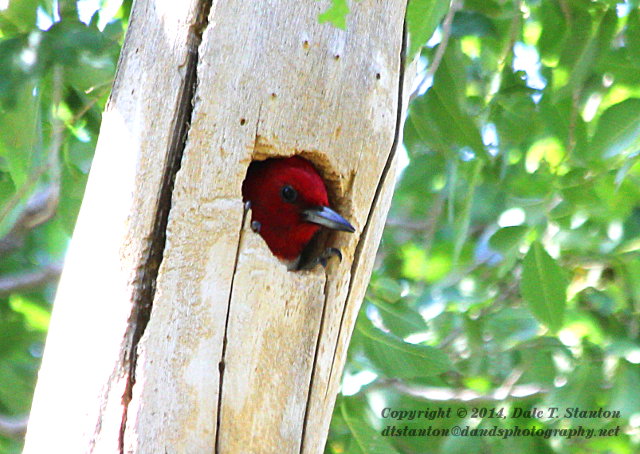
The Red-Bellied Woodpecker looks very similar to the Golden-Fronted Woodpecker elsewhere in this blog. Unlike most woodpeckers, Red-Bellies eat lots of plant material and seldom excavate the wood for insects. They forage in trees, on the ground, and even on the wing, eating insects, seeds, nuts, and fruit - sometimes tree sap, bird eggs, and small amphibians. Their "red bellies" are just a small area that is difficult to see in the field. Red-Bellied Woodpeckers live more than 20 years.

Male Red-Bellied Woodpecker
Female Red-Bellied Woodpecker
The Female does not have the continuous red cap that the male does.

White-Breasted Nuthatch

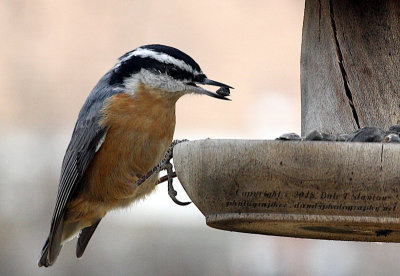
This little Nuthatch is a strange-looking creature as it moves headfirst down a tree trunk while foraging for invertebrates, seemingly not knowing which way is "up". It is known for wedging nuts and seeds into crevices and hacking them open with its beak. They nest in natural cavities in large deciduous trees, or even make use of abandoned woodpecker nests.

This Nuthatch poses with a nut he has wedged in the tree bark.
White-Breasted Nuthatch

White-Breasted Nuthatch
The White-Breasted Nuthatch is a common visitor to backyard feeders, but I have personally not seen any at mine yet. These were taken at Lake McClellan in the panhandle.

Monday, January 16, 2012

Blue Jay

I bought a small bag of salted in-shell peanuts and put them out for the birds. I'm glad it was a small bag, because it's not a good idea to use salted peanuts for birds. It's better to use unsalted peanuts for birds. The Blue Jays simply love peanuts in the shell, but the salted ones are not good for them. Too much salt is just as bad for them as it is us. So, later today I'll get some unsalted peanuts - in the shell.

(Blue Jay)
It's fun to watch the Blue Jays snatch them up and fly off to eat them nearby. Sometimes they'll take them about 10 yards away and eat them on the ground. Sometimes they'll head for the branches of a tree. This Jay found a 6" branch with an appropriate spot in our elm tree where he could safely open it up and "chow down" before returning for another.
.

Saturday, January 14, 2012

Ladder-Backed Woodpecker

This morning while checking my feeders, I heard the "tap-tap-tapping" common to woodpeckers. As I watched the branches of our Elm tree for the source of the sound, I caught sight of a bright red spot popping out from behind one. This is what I saw:

(Ladder-Backed Woodpecker)


The Ladder-Backed Woodpecker often feeds and nests in cacti in the Southwest. It's a small woodpecker that mainly feeds on insects such ants and beetles. Females generally like to feed in upper branches, whereas males tend to feed closer to the trunk or near the ground. This male was, however, feeding in the upper branches.  The Ladder-Backed Woodpecker is a year-round resident of the panhandle, albeit being a "rare to common" resident. They nest in trees, cacti, agave, yucca, or even a utility pole. The nests are likely drilled by the males, and lined with wood chips.
.

Yellow-Bellied Sapsucker

I found this photo from a couple years ago - April of 2010. It apparently slipped under my radar and I never identified it or pursued it.

(Yellow-Bellied Sapsucker)
The Yellow-Bellied Sapsucker winters in the panhandle. It "drills" wells in tree bark serve to collect sap, and attract bugs. The Sapsucker makes the rounds visiting its "wells" and eating the bugs it attracts. It also eats the sap, not by sucking as its name suggests, but lapping it up with its tongue - which resembles a paint brush.
.

Friday, December 30, 2011

Cooper's Hawk

It's not every day you see a Cooper's Hawk at your bird feeder. (This is my first sighting/identification of the Cooper's.)

While watching for photo-ops of various birds at my bird feeder this morning, I saw movement low in a lilac bush where its branches were dense. As I watched, this Cooper's hopped out onto the ground less than 7 yards from me - just long enough for me to get this shot. Unfortunately, I had to get it at an angle through a chain link fence.

Thinking about it, it's the perfect setup. A lilac bush isn't the deciduous forestry areas it normally prefers, but this Cooper's Hawk knew that the lilac bush was the staging area for sparrows - it being next to my feeder. The Cooper's main diet is birds - and they will chase them relentlessly through the woods. What better "diner" than an active bird feeder?  It was apparently trying to take advantage of that setup.

The Cooper's Hawk is not a stranger to the panhandle. We are in its breeding and year round range, as is most of North America.

 
Cooper's Hawk
.

Monday, December 26, 2011

Blue Jays

For a long time, I've been trying to get shots of blue jays, cardinals, etc. in our back yard. My wife had a new feeder waiting for me under the Christmas tree this year - one that she found on www.etsy.com. Made of cedar, it had a much better perch than my previous one had - one that I hoped would allow larger birds than mainly sparrows and house finches to feed.

I set it up yesterday while our white Christmas was still in the making. There was no activity at the feeder until this morning. I watched and waited.  At first only sparrows and finches showed up. After a little while my patience was rewarded, and jays finally made an appearance.  They easily helped themselves to their favorites in the mix I had waiting for them.

 The male first came in to test the waters.

 His mate followed shortly thereafter.

I will anxiously be awaiting more opportunities. I'll have to increase the sunflower seed content of the mix.

.

Thursday, August 18, 2011

Mississippi Kite

For days, we've been hearing a young Kite bawling quite often. We had a good idea where he was, but couldn't see him. I finally saw where he was yesterday. It seems they have a nest in a neighbor's tree that hangs over our driveway. It shouldn't be long before he tries his wings out.

Momma keeps a watchful eye on her little one.


I know he's being taken care of, because his momma was in the Elm in our back yard preparing a meal for him. I watched as she flew in and served his dinner.


(For more photos and info on Mississippi Kites, click HERE.)
.


Saturday, May 28, 2011

Mississippi Kite


Kites have been actively breeding here in the panhandle of Texas, even now at the end of May. There seems to be quite a bit more of them this year.

I have noticed something "different" about them this year. They are sporting rusty brown on their wings. I don't know if it's a variant coming out, an indication of maturity, or just an individual thing. Here are a couple of photos showing it:


(More Mississippi Kite photos and info HERE.)

If anybody has any idea about this, please let me know.
.

Sunday, May 8, 2011

Mississippi Kite

We've been getting fleeting glimpses of kites in the panhandle over the last couple of weeks. These two made an appearance yesterday in one of our trees. The upper one brought a grasshopper to the lower one. Hopefully, they will nest in a tree we can observe them in.

(More photos and info HERE.)

One thing I noticed about these is the rusty brown streaks on the wings. I've never noticed this coloration on Mississippi Kites before.
.

Saturday, February 5, 2011

Bald Eagle

A first for me, I saw this beauty fly over as I was watching a favorite hawk site. At first I thought it was a hawk, but soon realized that it was indeed a Bald Eagle - the symbol of The United States of America.


.

Saturday, January 22, 2011

Northern Harrier

The Northern Harrier winters over in the Texas panhandle. It rarely breeds here. Unlike many hawks, the harrier female is distinctly different in appearance from the male. It is also much larger. The Northern Harrier is up to 24" in length with a wingspan of up to 4 1/2 feet. This member of the hawk family has an owl-like facial disc that allows it to hunt by sound as well as sight. Its soft feathers allow for it to silently cruise low over fields, undetected by its prey. Using these ambush tactics, its prey stands no chance of escape.

(Female Northern Harrier)
(More images and info on the Northern Harrier HERE.)
.

Sunday, August 22, 2010

Blue Jay

This Blue Jay was a bit of a puzzle to me when I saw it. First of all, its body and tail appear to be fully matured. At the same time, its head appears to be that of a newly-hatched bird. Could it be that he just has a wet head for some reason? Is it some sort of genetic defect? I don't know.


Another puzzling thing is that it was imitating the call of the Mississippi Kite - a very good "PIT-tooooooooooo"! I've never heard anything like it before. It was very clear, albeit with a little "smaller" sound as if the volume was turned down a bit.

If you have any insight as to these mysteries, please post here or Email me (at the address on the photo) and let me know.

.